
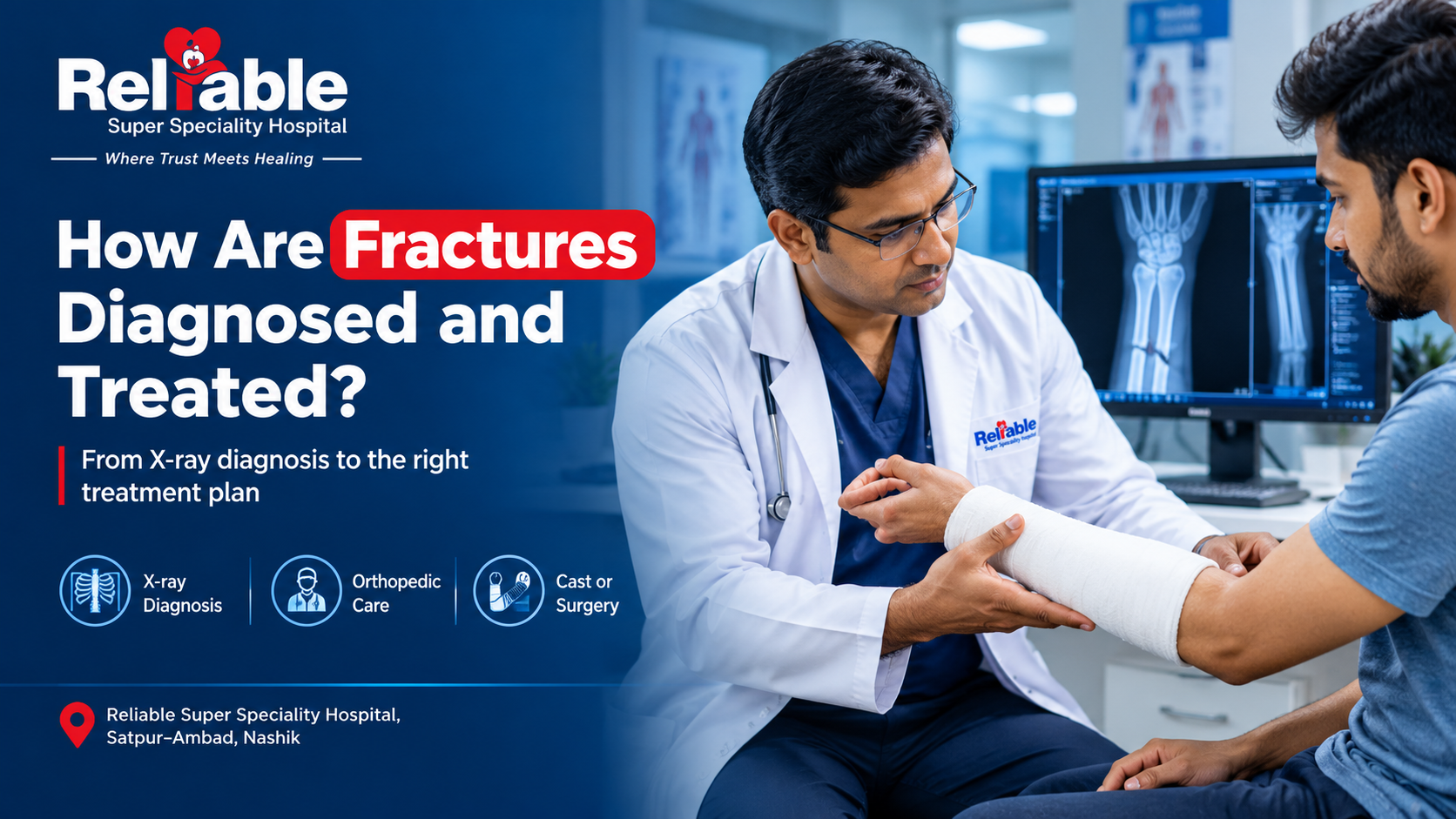
How Are Fractures Diagnosed and Treated?
A suspected fracture can raise several questions for patients and their families. Is the bone broken? Will a cast be enough? Is surgery necessary? How long might recovery take?
The answers depend on the type of fracture, the bone involved, the position of the broken fragments, the severity of the injury, and the patient's overall health. Understanding how fractures are diagnosed and treated can help patients prepare for an orthopedic consultation and make informed decisions about their care.
For people seeking fracture treatment in Nashik, the first step is an appropriate medical assessment. A healthcare professional can evaluate the injury, arrange suitable imaging when needed, and recommend a treatment plan based on the findings.
Quick Answer: How Are Fractures Diagnosed and Treated?
Fractures are usually diagnosed through a medical history, physical examination, and X-rays. Depending on the injury, a doctor may recommend a CT scan or MRI for further assessment. Treatment may include immobilization with a cast or splint, realignment of the bone, or surgery to stabilize the fracture. The appropriate approach depends on the fracture's location, stability, alignment, and severity.
A suspected fracture should be assessed promptly. An open wound over a suspected fracture, significant deformity, uncontrolled bleeding, or a cold, pale, numb limb requires urgent medical attention.
What Is a Bone Fracture?
A fracture is a break or crack in a bone. It can occur after a fall, road accident, sports injury, direct impact, or workplace incident. Some fractures happen when weakened bones break under relatively minor stress.
Fractures vary considerably in their severity. A small crack may need protection and monitoring, while a displaced or unstable fracture may require the bone to be realigned or surgically stabilized.
The presence of pain or swelling alone does not confirm a fracture. Sprains, dislocations, and other soft-tissue injuries can produce similar symptoms, which is why proper evaluation matters.
What Are the Common Types of Bone Fractures?
Doctors classify fractures according to the pattern of the break, whether the skin is damaged, and whether the bone fragments have moved out of their normal position.
Common types include:
- Closed fracture: The broken bone does not communicate with the outside through an open wound.
- Open fracture: A wound exposes the fracture or connects the fracture site to the outside environment. This requires urgent assessment because of the risk of infection and associated tissue damage.
- Displaced fracture: The broken bone fragments have shifted out of their normal alignment.
- Non-displaced fracture: The bone has broken but its fragments remain reasonably aligned.
- Comminuted fracture: The bone has broken into multiple fragments.
- Stress fracture: A small crack develops from repetitive loading or overuse.
- Greenstick fracture: An incomplete fracture that commonly occurs in children because their bones behave differently from adult bones.
These categories can overlap. For example, a fracture can be both displaced and comminuted. The classification helps the orthopedic specialist determine the most appropriate management.
What Are the Signs and Symptoms of a Fracture?
Symptoms vary depending on the injured bone and the nature of the injury. Common signs include:
- Pain at or around the injured area
- Swelling and tenderness
- Bruising or discoloration
- Difficulty moving the affected limb or bearing weight
- An unusual shape or visible deformity
- Reduced function of the injured body part
Not every fracture causes obvious deformity, and some people can still move an injured limb despite having a fracture. Being able to walk or move a joint does not reliably rule out a broken bone.
When Does a Suspected Fracture Become an Emergency?
Seek urgent medical assessment if an injury involves:
- Bone visible through a wound or a deep wound over the suspected fracture
- Significant deformity or a severe crush injury
- Heavy or uncontrolled bleeding
- A hand or foot that becomes cold, pale, blue, or numb
- Severe or rapidly worsening pain or swelling
- A suspected fracture involving the head, neck, back, pelvis, or major trauma
Call emergency services when the injury is severe or moving the patient could worsen the situation. Do not attempt to straighten the limb or push exposed bone back into the wound.
How Are Fractures Diagnosed?
Accurate fracture diagnosis helps the treating team understand the injury and choose an appropriate treatment method. The assessment generally involves several steps.
1. Medical History and Physical Examination
The doctor asks how the injury occurred, where the pain is located, and whether the patient has noticed swelling, numbness, or difficulty moving the affected area. Information about existing medical conditions, medicines, previous fractures, and bone health may also be relevant.
The physical examination may include checking tenderness, swelling, alignment, movement, skin damage, and circulation or sensation beyond the injury.
The injured area should not be forced through painful movements simply to test its function.
2. X-Ray Examination
An X-ray is commonly the first imaging test used for suspected fractures. It can show many bone breaks, their location, and whether the fragments appear displaced.
The number and views of the X-rays depend on the bone and injury. If the first X-ray is normal but the doctor still suspects a fracture, additional imaging, repeat imaging, or follow-up assessment may be needed.
3. CT Scan or MRI, When Required
Additional imaging is not necessary for every fracture.
- CT scan: May be recommended when a fracture is complex or involves a joint or an area where detailed bone anatomy is important.
- MRI: May help identify certain fractures that are not visible on initial X-rays, as well as associated injuries to soft tissues, ligaments, or other structures.
The choice depends on the clinical findings and the suspected injury. Patients should not assume that every fracture requires advanced imaging.
4. Assessment of the Fracture's Stability
After reviewing the examination and imaging, the doctor considers whether the fracture is stable, whether the bone is aligned, whether a joint is involved, and whether nearby nerves, blood vessels, skin, or soft tissues may be damaged.
This assessment guides the decision between non-surgical treatment and an operation.
What Are the Treatment Options for a Fracture?
Fracture treatment depends on the type, location, alignment, and stability of the break. Many fractures can be treated without surgery, while others require realignment or surgical fixation.
1. Cast or Splint for a Broken Bone
A cast or splint keeps the injured bone protected and limits movement while healing takes place.
A splint may be used initially when swelling is expected, or when temporary support is needed. A cast may provide more complete immobilization when appropriate.
During treatment, patients should follow the clinician's instructions about movement, weight-bearing, keeping the cast dry, and attending follow-up appointments.
Seek medical advice promptly if a cast or splint becomes excessively tight, pain or swelling increases significantly, or the fingers or toes become numb, cold, pale, or blue.
2. Closed Reduction
If the broken bone fragments are out of position, the doctor may recommend a procedure called reduction to restore better alignment. In a closed reduction, the bone is repositioned without surgically opening the fracture site.
Pain relief, sedation, or anesthesia may be required depending on the injury and the procedure. A cast or splint is often used afterward to maintain the corrected position.
Not every displaced fracture can be managed this way. The stability of the fracture and whether the alignment can be maintained are important considerations.
3. Fracture Surgery and Internal Fixation
Some fractures require an operation to restore alignment or provide stable support. Depending on the fracture, surgical fixation may use plates, screws, rods, pins, or other appropriate devices.
Surgery may be considered for certain open fractures, unstable or significantly displaced fractures, some fractures involving joints, or injuries that cannot be adequately aligned and maintained with non-surgical treatment.
An operation is not automatically necessary just because a bone is broken. The orthopedic specialist should explain why surgery is being considered, what alternatives exist, and what the potential benefits and risks are.
4. External Fixation
In selected cases, a frame outside the body is connected to the bone using pins or wires to help maintain alignment. External fixation may be useful for certain complex injuries, particularly when the surrounding soft tissues need special consideration.
This technique is not needed for most uncomplicated fractures.
5. Pain Management and Rehabilitation
Pain relief may be recommended according to the patient's age, medical history, other medicines, and the nature of the injury.
Once the fracture is sufficiently stable, the doctor may advise specific exercises or physiotherapy to help restore movement, strength, balance, and function. The timing depends on the fracture and the treatment provided. Starting strenuous activity too early can interfere with recovery.
What Affects the Fracture Healing Process?
Bones heal through a natural process in which new tissue forms around the fracture and gradually strengthens. The time required varies substantially from one person and fracture to another.
Factors that may influence healing include:
- The bone involved and the fracture pattern
- The amount of displacement and stability
- Damage to surrounding skin and soft tissues
- Age and general health
- Blood supply to the injured area
- Smoking and nicotine use
- Nutritional status and certain medical conditions
- Whether the recommended treatment and follow-up plan are followed
Some fractures heal over several weeks, while others need several months or longer. An exact recovery time cannot be predicted from the fracture name alone.
Follow-up examinations and X-rays, when indicated, help the doctor assess healing and decide when to adjust immobilization, allow weight-bearing, or begin further rehabilitation.
What Should You Do If You Suspect a Fracture?
Taking sensible precautions before medical assessment can help avoid further injury.
- Stop the activity. Do not continue walking, lifting, or using the injured limb if doing so causes pain or could worsen the injury.
- Keep the area supported. Immobilize the injured part in the position found, if you can do so safely, without forcing it straight.
- Protect an open wound. Cover it with a clean dressing. Do not push exposed bone back inside or apply pressure directly to exposed bone.
- Use a wrapped cold pack if appropriate. Apply it gently around the injured area, avoiding direct contact between ice and skin. Do not delay emergency care to do this.
- Seek appropriate medical evaluation. Serious injuries require emergency assessment. Less severe suspected fractures still need timely evaluation.
- Follow medical instructions. Avoid putting weight on the injured limb unless advised that it is safe.
If you suspect a serious neck, back, pelvis, or major limb injury, do not move the person unnecessarily. Call emergency services and follow the instructions provided.
When Should You Consult an Orthopedic Specialist?
An orthopedic consultation may be appropriate when a fracture is suspected, imaging has identified a fracture, pain or swelling persists after an injury, or a patient needs guidance about treatment and recovery.
Consultation is particularly important when:
- An X-ray has confirmed a fracture and a treatment plan is needed.
- A fracture may be displaced, unstable, or close to a joint.
- The patient has difficulty bearing weight or using the affected limb.
- Symptoms persist despite initial treatment.
- A cast or splint is causing concerning symptoms.
- A second opinion is needed to understand surgical and non-surgical options.
For a serious injury, do not wait for a routine appointment. Seek emergency care first.
Questions to Ask Your Doctor About Fracture Treatment
Patients and family members can use the consultation to understand the diagnosis and make informed decisions. Useful questions include:
- Which bone is fractured, and what type of fracture is it?
- Is the fracture displaced or unstable?
- Is a cast or splint sufficient, or is surgery being considered?
- What are the benefits and risks of each suitable treatment option?
- Can I put weight on the injured limb?
- How should I care for the cast, wound, or surgical site?
- When should I return for follow-up or repeat imaging?
- What symptoms should prompt urgent medical attention?
- When might rehabilitation or physiotherapy be appropriate?
Bring existing X-rays, scan reports, prescriptions, a list of current medicines, and information about relevant medical conditions to the appointment, if available.
Fracture Treatment in Nashik: Getting the Right Assessment
Patients in Nashik, including those living or working around Satpur and Ambad, may need fracture assessment after a fall, sports injury, road incident, or workplace accident.
The appropriate care pathway depends on the severity of the injury. Some fractures can be managed with immobilization and scheduled follow-up, while more complex injuries may require emergency stabilization, imaging, orthopedic assessment, and surgical care.
Reliable Super Speciality Hospital, located on Satpur–Ambad Link Road, opposite Bajrang Nagar, Nashik, Maharashtra 422010, is a 50-bedded multi and super speciality hospital with 24×7 emergency and trauma care, ICU care, modern diagnostic support, and orthopedic and trauma services.
For patients with a suspected fracture, the next step is to obtain an appropriate medical assessment and understand the treatment options relevant to the individual injury. If there is severe deformity, an open fracture, uncontrolled bleeding, or a cold or numb limb, seek emergency care without delay.
Conclusion
Fractures are diagnosed through clinical assessment and usually X-rays, with CT scans or MRI used when additional information is needed. Treatment may involve a cast or splint, bone realignment, surgery, and rehabilitation, depending on the injury.
The right approach is not the same for every patient. Timely assessment, a clear treatment plan, and appropriate follow-up can help patients understand their options and support the healing process.
If you suspect a fracture or have questions about an existing diagnosis, consult a qualified orthopedic specialist. For serious injuries, seek emergency medical attention promptly.
15. FAQ SECTION
1. How are fractures diagnosed?
Fractures are usually diagnosed through a physical examination and X-rays. A doctor may recommend a CT scan or MRI when the fracture is complex or an initial X-ray does not explain the symptoms adequately.
2. Can a fracture heal without surgery?
Yes. Many fractures can heal without surgery using a cast, splint, or other appropriate immobilization. Surgery may be necessary for certain displaced, unstable, open, or complex fractures.
3. Is an X-ray always necessary to diagnose a fracture?
X-rays are commonly used to diagnose fractures, but the required tests depend on the injury. If a fracture is still suspected despite a normal X-ray, the doctor may recommend additional imaging or follow-up.
4. How long does a broken bone take to heal?
Healing time varies with the bone involved, fracture severity, age, general health, and treatment. Some fractures heal within several weeks, while others may take months or longer. Follow-up helps assess progress.
5. What is the difference between a cast and a splint?
A cast provides firm support around an injured area, while a splint generally provides support to part of the limb and can accommodate swelling more easily. The choice depends on the injury and stage of treatment.
6. When does a fracture require surgery?
Surgery may be recommended when a fracture is significantly displaced, unstable, open, involves certain joint surfaces, or cannot be adequately aligned and maintained without an operation. The decision depends on individual clinical findings.
7. Can I walk if I have a fracture?
Some people can walk with certain fractures, while others cannot bear weight. Being able to walk does not rule out a fracture. Avoid putting weight on the injured area until you have received appropriate medical guidance.
8. Where can I seek fracture treatment in Nashik?
Patients can seek evaluation from an appropriate orthopedic service or emergency department, depending on the severity of the injury. Reliable Super Speciality Hospital in the Satpur–Ambad area of Nashik provides orthopedic and trauma support and 24×7 emergency care.
Need an Orthopedic Consultation?
A suspected fracture needs appropriate assessment to determine the type of injury and the treatment it requires. Consult a qualified orthopedic specialist to discuss your diagnosis, available treatment options, and expected follow-up.
Reliable Super Speciality Hospital
Satpur–Ambad Link Road, Opp. Bajrang Nagar, Nashik, Maharashtra 422010
For severe injuries, open fractures, uncontrolled bleeding, or signs of impaired circulation, seek emergency medical care immediately.
Suggested website link: Reliable Super Speciality Hospital